This message offers a poignant reflection on Psalm 90, contrasting the majestic, eternal nature of God with the brevity and fragility of human existence. This Psalm is a song of Moses, contextualized within the sorrowful events of Numbers 20—including the deaths of Moses’ siblings Miriam and Aaron and the judgment preventing him from entering the Promised Land. Studying this psalm helps us to visualize the seriousness of sin and the reality that earthly time is fleeting. The sermon urges us to “number our days” to gain a heart of wisdom, and challenges us to redeem our limited time by living for God’s glory rather than wasting it on temporary pursuits. As our church looks toward the future year of 2026, our prayer is for God’s satisfying mercy through Jesus Christ and a plea for Him to confirm and establish the work of our hands.
Transcript
If you would open your Bibles with me to the Psalms, and I’m going to read through Psalm 90. I’ve already read two verses of this this morning, but I’m going to repeat those, and then I’ll read to the end of this Psalm. I thought this might be an appropriate Psalm in thinking about God’s blessing on us over the past years and year, and as we look forward to this next year and the future of this church. I think this is a great hymn to look at. It is a very somber hymn, I have to say, but it is not… It shouldn’t be a hymn that discourages us in any way. It is a Psalm where Moses deals with the realities of life and the reality of death and looks to God for blessing. It is not a Psalm in which he shows any… He’s not regretful or resentful of anything that God has done. There’s no resentment in what he has in these words. There is instead a great hope in God that we need to see and a great gratitude to God for what he’s done. Even though, as we’ll look at in a few moments, it is a very serious, very serious Psalm.
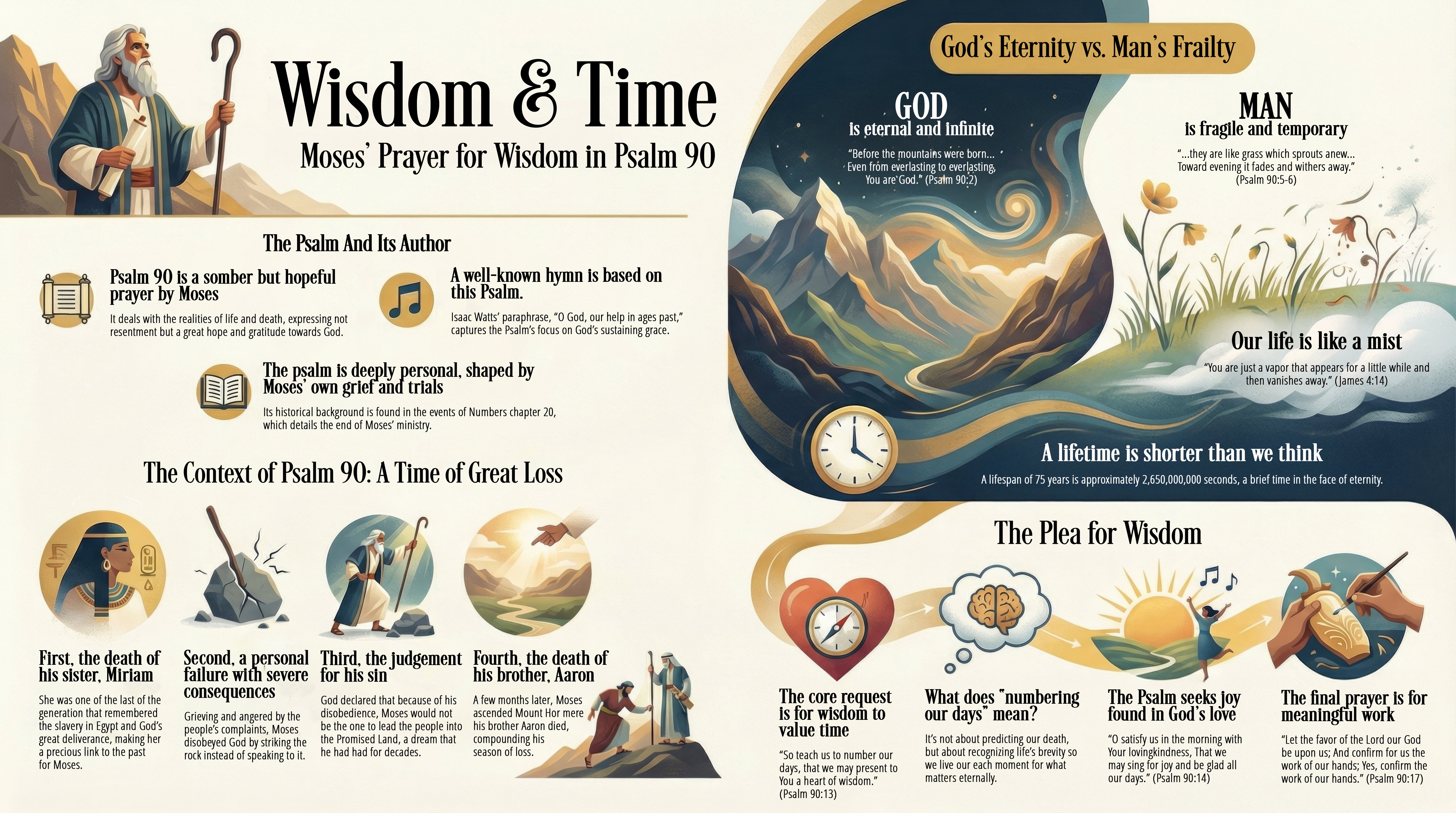
We sing this Psalm, the Isaac Watts paraphrase of this from time to time, “O God, our help in ages past, our hope for years to come, be thou our guard while troubles last in our eternal home.” This is God’s holy Word, the Psalm of Moses, God’s eternity in man’s transitory-ists. And this whole Psalm is a prayer. I should mention that as we read God’s inerrant Word.
“Lord, you’ve been our dwelling place in all generations. Before the mountains were born, or you gave birth to the earth and the world, even from everlasting to everlasting, you were God. You turned man back into dust and say, “Return, O children of men, for a thousand years in your sight, or like yesterday when it passes by.” Or as a watch in the night, you have swept them away like a flood. They fall asleep in the morning. They’re like grass which sprouts anew in the morning. It flourishes and sprouts anew toward evening. It fades and withers away. For we’ve been consumed by your anger and by your wrath we’ve been dismayed. We have placed our iniquities before you, our secret sins in the light of your presence. For all our days have declined in your fury. We have finished our years like a sigh, and for the days of our life they contain seventy years, or if due to strength eighty years. Yet their pride is but labor and sorrow, for soon it’s gone and we fly away. Who understands the power of your anger and your fury according to the fear that is due you? So teach us to number our days, that we may present to you a heart of wisdom. Do return, O Lord. How long will it be? And be sorry for your servants. O satisfy us in the morning with your loving kindness, that we may sing for joy and be glad all our days. Make us glad according to the days you’ve afflicted us and the years we’ve seen evil. Let your work appear to your servants in your majesty to their children. Let the favor of the Lord our God be upon us and confirm for us the work of our hands. Yes, confirm the work of our hands.” —Psalm 90
Opening Prayer
Let’s ask God to bless His holy Word to our hearts. Father, as we reflect on this beautiful and poignant psalm, we ask Father for the insight that you have for us in this Word. We thank you, Father, for your sustaining grace and for the greatness of the God that you are. And we recognize the truth of our feebleness before you. And we ask, Father, that you give us wisdom as we study this passage. And, Father, that you guide our hearts and minds as we look to the future and to your future grace and blessing. Please hold us up and help us, we pray today, as we study Psalm 90 and reflect on Moses’ song. We ask this in Jesus’ name. Amen.
The Brevity of Life
Well, part of the lesson of the psalm is that life is brief and time ticks away. It’s really interesting. Life ticks by one second at a time. There are 2,650… No, I’m off already. There are 2,650,000,000 seconds in 75 years. That sounds like maybe a lot, unless you’re 72 years. It doesn’t sound like very long at all. Part of the lesson here is that our days are numbered. We live in this world a very brief amount of time. God uses us in this time, and we need to think about the time we’ve got left, how much time we have left. So we’re going to explore this psalm. We’re going to look at this together, and we’re going to think about this and reflect on these words of Moses.
When Isaac Watts wrote his hymn, and he wrote, “Our God, our help in ages, past, our hope for years to come, our shelter from the stormy blast, and our eternal home,” you remember his words in that psalm. His focus is on God and his sustaining grace, and he recognizes two things that Moses recognizes in the psalm as well. One is that life is very brief for us because of the nature of sin and the judgment of God. To paraphrase this, Psalm Watts wrote, “Time like an ever-rolling stream bears all its suns away. They flab forgotten as a dream dies at the opening day.” It is so true, and it’s exactly what Moses is writing in this psalm. You go through life, the people that you live with, we live a certain time and we die, and this world doesn’t remember you very long. Not too long at all. You become a memory that fades. You’re like a dream that dies when you wake up in the morning. You can’t remember it. That’s the way life is in this world. And that’s, you know, if I stopped there, it’d be rather depressing, wouldn’t it? We’re going to look at it a little more deeply and see what it was that motivated Moses as he writes the psalm.
God’s Greatness and Man’s Frailty
I want us to think about the background of the psalm. And, of course, we do have to deal with the reality of this message. Probably the first point that the psalm does make, the first point is that God is great and he endures forever. And the second, in contrast to that, is that we are not great. And we are very fragile, and we fade, and we’re dependent upon our great God. We’re dependent on our God for our very next breath, and we have no promise that we will get it. If it comes to us, it’s purely by the grace of God. And so we look to him and recognize his greatness and recognize our fragility, our, the briefness and the fragile nature of human life.
When Moses, you know, this isn’t the only psalm that Moses wrote. It’s the only psalm in the collection of psalms that Moses wrote. He wrote two other psalms. He wrote a psalm in Exodus when Israel comes out of the Exodus, God parts the waters as the waters close over the Egyptian army, and they’re delivered. Moses writes a psalm of praise, and it’s pure praise, and they all sing that beautiful psalm of praise. And then at the end of his life, he wrote two psalms. He wrote this psalm, and he wrote another psalm that reflects the sinful nature of Israel and their struggles. And it’s a very somber psalm. But of all of these songs that Moses wrote, this is the most personal. And to understand the background of the psalm helps us both in understanding what the psalm means, and also in understanding how we apply it to ourselves, what it means to us.
The Historical Context: Numbers 20
And so, as we think about this psalm, we find the history in the book of Numbers, chapter 20. And I’m going to turn to that passage, and as I talk about it, I’m not going to read Numbers 20. But we need to understand the contents of Numbers 20, so that we can understand Psalm 90. So, let’s just reflect on what this psalm is about. This is the very end, Numbers 20. This is the beginning of the very end of Moses’ ministry. And Psalm 20 begins with the children of Israel, the whole congregation. They come to the wilderness of Zinn. They stay in the area called Kadesh. And it says, “Miriam died there and was buried there.”
The very first thing that happens in chapter 20 is the death of Miriam, Moses’ sister. And there’s not much said about her. It’s about seven words here. “Miriam died and was buried there.” It’s a very short obituary. And yet, it’s something that must have greatly impacted Moses. I want us to think about the impact that Miriam’s death probably had on Moses, because she would have been very precious to him. Miriam. She was older than he was, if you remember. Miriam’s his older sister. She’s older than Moses and Aaron. And she wasn’t perfect. You might remember back in Numbers 12 that she and Aaron objected to Moses’ authority. And there was that little tension there, which didn’t go well for Miriam or Aaron. You know, they corrected and mended their ways very quickly. But nevertheless, Miriam was Moses’ sister. And she’s like the last rose of summer. I don’t know if you remember or are familiar with Thomas Moore’s poem, “Tis the last rose of summer, left blooming alone, all our lovely companions are faded and gone.” That’s Miriam. If ever that’s a description of a person in the Bible, of a lady in the Bible, that’s a powerful picture of Miriam. And that’s because she’s the last, she’s among the very last of her generation.
The Passing of a Generation
When you get to Numbers 20, you know, at the beginning when Moses led the people out of Israel, he led out, it says, “603,550 men plus women and children.” That’s who came out of Egypt into eventually get into the Promised Land Israel. That’s more than a million people. What happened to those people? They all died in the wilderness. All of them. A new generation is born. All of these people, all of them, have fallen in the wilderness over the 38 years that they’ve been there, the 40 years. They’ve been since, they spent 40 years there. And so these 38 or so years we’re looking at, they’ve all fallen in the wilderness. There’s only Moses and Aaron and Miriam and Joshua and Caleb left. That’s pretty much it.
So Miriam is one of the few people that Moses would be able to talk to who remembered, who remembered the working of God, who remembered the misery and the slavery of Egypt, who remembered the little basket that was put in the Nile River that she followed it through as it floated through the reeds, saw the princes of Egypt take it up, took the baby out and named the baby Moses. She was the one who remembered and saw these things. She was there with Aaron and Caleb and Joshua when they came out of Egypt, when God parted the waters and they walked through that great wall of waters on each side. She would have remembered those days. She would have remembered the great deliverance of God. The people around them who were born in the wilderness had no memory of that. They only had the stories, stories from people like Miriam and Moses and Aaron and Caleb and Joshua. So you can imagine how precious it is to have friends who remember the things that are so precious to you.
Moses’ Sin and God’s Judgment
So yes, when Miriam dies, it’s the beginning of this chapter. What happens next? The very next thing that happens in chapter 20 is that they’re in Kadesh and there’s no water, and the people complain. Now, Moses is obviously grieving the death of his sister Miriam, and he’s given this test of faith because the people come rise up and they’re complaining. You know, you brought us out here, we might as well die. We’d be better off dead. And Moses gets angry. God had given him, told him exactly what to do to make provision for them. “Take your staff,” he says, “and speak to the rock, and the water will flow.” Moses is angry. He curses the people. You know, he takes his staff and he hits it twice, and out of abundant grace, the water does flow. God provides provision for the people of Israel.
You would think that after 40 years of incredible patience, been finally losing your patience that one time, you know, is it exactly just what happens next? It’s absolutely just. We don’t understand justice. Moses sins. He disobeyed the Word of God, and he’s the leader of Israel, and God doesn’t treat sin lightly. So he says to Moses, “Because of your sin, you’re not going to lead the people of Israel into the Promised Land.” He’s been looking forward to this, waiting for this for 40 years. And he’s not going to enter into the Promised Land. I’ll take you up and you can see it, but you can’t walk in it. You won’t enter the Promised Land leading your people. That’s hard news, the judgment of God for sin. We need to understand the sinfulness of sin so that we don’t sin. God doesn’t treat sin lightly.
The Death of Aaron
So he sins. What happens next? Well, the next thing that happens is a few months later, is that God says to Moses, “Go up to Mount Horr, and go up to Mount Horr. And take the robes off your brother Aaron, and place them on his son.” It was on that mountain that his brother Aaron dies. So you have these two deaths, and this death of his hope, and all this surrounding Moses. And so, in light of this chapter, Moses writes a song. The song that we are reading in Psalm 90.
And he begins with the greatness of God. God is majestically great. “Lord, you’ve been our dwelling place in all generations. Before the mountains were born, you gave birth to the earth and the world, even from everlasting to everlasting your God.” God is great and he’s infinite. And look at the contrast. The frailty of man and the greatness of God. Look at the contrast. Look at the contrast. In this world, we don’t have any sure place. And we’ve been very fortunate to live in our house for 20 some years. But you don’t have any guarantee that you’re going to be in any one place for too long. Now think about Justin. He’s wandered around the world for the last year and a half. And it’s a figure of all of us. We just are transitory as we move through this life. Well, from one place to the next, maybe we can live in one spot for a while, but we’re not going to live here forever. We, as the writer of Hebrews says, just like the Moses and Abraham and the patriarchs, we look forward to a city with foundations whose architect and builder is God. We don’t have any security in this world, in this life.
The Fleeting Nature of Time
Our life is fragile and one thing that we can be sure of is that it’s going to come to an end. That’s why in verse 12 it says, “Teach us, Lord, to number our days so that we may gain a heart of wisdom.” That’s why James 4, 14 says, “Yet you don’t know what tomorrow will bring. What’s your life? For you’re a mist and it appears for a little time and then vanishes away.” That’s why Psalm 39, 4, and 5 says, “O Lord, make me know my end and what is the measure of my days. Let me know how fleeting I am. Behold, you’ve made my days a few handbreadths, and my lifetime is like nothing before you.”
When Moses is writing and he says, and he talks about the nature of God, “For a thousand years in your sight is like yesterday when it passes by.” That doesn’t mean that time is short for God. What that means is that time is short for us. That’s his point. If you lived as long as… What’s his name? Methuselah. If you lived as long as Methuselah, you lived for roughly a thousand years. It was like an evening gone when you get to the end of it.
I remember when my mom, in her last year of living, she needed care. And so Vicki and I would stay over at her house at night. Every evening we’d go over there and spend the night there. And sometimes she talked in her sleep. And if she was dreaming, sometimes she’d reflect those dreams. And one of the things that was poignant to me, that really happened, one night I’m listening, because I would listen for her all night. If she wakes up, I wanted to know. And I’m listening, and all of a sudden she starts calling out to mama. She’s having a dream, and she’s a little girl again in that dream. She’s six years old, and she needs her mama, and she’s calling out to mama. She wasn’t six years old, she was 95 years old. You know what? It’s a brief time. 95 years is nothing. It’s nothing.
We need to recognize that life is very short, and it ends in judgment, and ends in death. And it’s certain. But we also need to know that we celebrate Christmas. That the very reason that Jesus came is so that he could put an end to the power that Satan has in causing us to tremble and fear over death, because death for a believer becomes a doorway to heaven. And we need to recognize the beauty of what Christ has done for us, and the fact that we do have a home. If you have trust in Jesus Christ, you’ve got an eternal home in God forever and ever. And so, yes, you turn men to dust, saying, “Return to dust, O sons of men.” Peter picked up on that verse when he said, “With the Lord a day is like a thousand years, and a thousand years is like a day.” Yeah. God is patient. He doesn’t come and bring the judgment right now, because out of his mercy, Peter’s point there, is that he’s giving people time to repent, come to faith. But still, life for us is so short. And if we’re wise, we will do what this passage is teaching us to do to number our days.
The Consequences of Sin
Why is it that we die? Well, we die because Adam sinned, and we were born in that sinful state. And we die because we sinned. We’ve sinned in our lives, and the consequences of sin is death. The consequences of sin is always death. And death to hopes and plans, just like Moses. Moses is longing, looking for, finally, we’re going into the Promised Land. I’m leading my people under the Promised Land. Those are hopes and dreams. His sin brought a death to those dreams and those hopes. Brings an end to relationships. Sin brings death. It brings an end to our health. Sin ultimately leads to spiritual death, eternal separation from God, unless by the power of God’s abundant grace and Jesus Christ, we have turned to Him, and our sins have been washed away in His blood, His payment that He’s made for us on the cross. You know, we can’t treat sin lightly. And we should be praying like David prayed in Psalm 19. “Keep your servant also from willful sins. May they not rule over me.” That’s a prayer we should pray every day. I don’t pray that prayer every day, but I tell you, I should pray that prayer every day. And we should be very careful about sin in our life.
Part of the wisdom of numbering our days isn’t so that we will know how much time we’ve got left. The point of that is so that we take these moments of our life that are left and live them for God. That we take that time and we spend the time on the things that matter eternally. That’s what wisdom is. Living godly, morally, according to the Word of God, seeking Him and a relationship with Him, turning away from our sin and looking to Him. So, we need to recognize that sin is costly. It leads to God’s judgment. That’s what that whole section is about.
The next section. “We’ve been consumed by your anger and by your wrath we’ve been dismayed. You’ve placed our iniquities before you, our secret sins in the light of your presence, for all our days have declined in your fury and we’ve finished our years like a sigh.” Think of Moses writing those words as he sees all of the death. How many funerals has he witnessed over the death of that entire generation? God had raised up a new generation with millions of probably at least two million people. But that entire generation didn’t live to see the fulfillment of the promise of entering into the promised land. He’d seen the death and it’s because of their sinfulness, their stubbornness. “And so he pleads for wisdom and for restoration. Teach us to number our days that we may gain a heart of wisdom.” That’s the first thing.
Gaining a Heart of Wisdom
“Teach us the number of days are right that we may gain a heart of wisdom.” You may live average, on average, looks around most of these people died about 70 years of age. Some of them hang on to be 80. A few like Moses lived much longer. Moses 120. Miriam was older than Moses when she died. 120 years is a short time to live in this world, comes to an end. How do you gain this wisdom? Well, by recognizing that we only have so much time, you know, I’m 72 years old, 72. I think I’m 30. I really do. From day to day, I rarely think of myself being the age that I am. And I don’t think much about very often about how many years I got left. From time to time, God has called my attention to it. And yet, you don’t tend to think about it. What are we spending our time on? Yeah, we have the same amount of time. And whatever you do with that time, you exchange it for something. That’s what it means to redeem the time in the New Testament. We take that period of time, something, and we exchange it for something. Soot in front of a television set and for an hour and we, what do we get? We get some sort of pleasure out of that, I suppose. And some kind of a memory, I suppose. I don’t know that it’s a good one. And of all the things you spend your time on, the only things that’s going to matter ultimately are those things that you’ve done for the Lord in faith, in faith for the Lord. And nothing else is going to matter.
A Life Worth Living
You get older, and I suppose the older you get, the less concerned you are about telling people how old you are. After a while, you begin to think it’s an achievement to be another year older. And after a while, over the past few weeks, the media has covered Dick Van Dyke’s 100-year birthday quite a bit, you know, with interviews with him and various things. And he’s 100 years old, and they’ve made a lot out of it. And it’s a great thing. I mean, I’m glad he’s 100 years old. That’s good for him. But living another year isn’t an achievement in itself. You can have an incredibly worthwhile and rich life and die at 26 or even younger. Some people have lived wonderful lives and died early. Jim Elliot would be a good example of that. Borden. And well, there are just dozens of those who God used in powerful ways to impact people. And with bringing great blessing, that’s a life worth living. It’s a life worth living. Are you going to live 72 years like I have and then wonder about it? I expect Moses was wondering about it just a little bit, even though he had accomplished great and wonderful things. And he knew the Lord intimately. He had followed those people around the wilderness in those circles for four years. And he’s not going to complete his plan. And so he must think, you know, did I do anything? Have I accomplished anything? Because I haven’t completed the plan.
That’s why these last verses are so important. Moses isn’t resentful. No, he’s looking to the Lord. He says, satisfy us in the morning with your loving kindness, that we may sing for joy and be glad for all our days. Be glad all our days. That’s where joy comes from, by the way, knowing the love of God and His grace, His abundant mercy that He’s given us in Jesus Christ. That’s where our hearts find true joy. Make us glad according to the days you’ve afflicted us. He’s got to be talking about those years in the wilderness. The years that we’ve seen evil, let your work appear to your servants and your majesty to the children. You know, you pastor churches for a few years, and there are times when you think you’re going in circles. You know, you’re wandering around and you don’t know if you’re ever going to come out of the wilderness or not. But God uses those wilderness experiences for good, and we have to keep that in mind. God raised up a nation, a blessed people in that wilderness. They went in as slaves. The people came out as a nation. And God used that nation of grace to bring our Lord Jesus Christ into this world and bring salvation to us. That was Moses’ ministry. In fact, have you bet it was? It’s wonderful.
Confirming the Work of Our Hands
And so Moses’ prayer at the end of this is that, “Let the favor of the Lord God be upon us and conform for us the work of our hands.” Don’t let it be from not the Lord. The work that we’ve done, make the most of it more. It’s going to come only with your blessing. Only with a blessing of God. Make the most of the work of our hands. Just conform the work of our hands. That’s our prayer. That’s Moses’ prayer. That is our prayer. It’s our prayer for this church, for this work. The God bless the efforts that everyone here has put into that. The work that the church positioned eczema, syndrome, asthma, serious healing, may be produced by Mount Jesus Christ in ours. how I was there. It made me feel welcoming. Gillette’s delighted. That was it. He just wanted me to know that he came across that note. He’s thankful for what he was able to do here. He felt so grateful that he could be here for a time and see this church continue with this ministry. And his blessings blessed me. To be used of God. What’s his prayer there? His prayer is Moses’ prayer. Lord, bless the work of my hands. May it amount to something, or let this thing grow into something worthwhile and good.
It’s my prayer. It’s my prayer. May this church grow into something good. As we look at 2026, which is going to be quite a year, I expect. I don’t know what God will do here. I have no idea. But I trust God for His goodness. And I believe that He will bless the world. I believe that we will grow stronger in the Lord, getting maturity with Him, more Christlike, each one of us. And I believe that He will build up this world. And I believe that we’ll see someone come to faith. We’ll see people come to faith in Jesus Christ and be transformed from that world of darkness into the Kingdom of Christ. That’s what I’m going to see. That’s what I pray for. And I pray that that’s your prayer as well.
Closing Prayer
Let’s look to Him and ask this question. Father, we do have you recognizing that you’re the one who sustains us. You hold us up. You bless us, Lord. And Father, you are God of judgments, and you judge your sin, and we live in a world full of sin. And Father, we feel the consequences. We are fragile before you. There’s nothing. We have but the next breath that you give us. We pray, Lord, that these breaths that you give us, we stand for your glory. Help us to consider the time before us. The time that we have in the past is past. You give each one of us more time, more days, more seconds to serve you. Lord, bless us as we look to you. Father, help us to spend this time for your glory and doing your work so that we can see people blessed and our Savior, the Lord Jesus, glorified. Please hear this prayer in the morning and answer it and help us see the fruit in the coming months. We ask this in Jesus’ name.